UBC Engineering Physics Capstone · Project 2561 · Wayve
Small cars.
Real-world learning.
Multi-agent reinforcement learning for autonomous micro-scale driving.
We built a physical training platform around modified 1:64 RC cars: learn to drive in NVIDIA Isaac Lab, transfer PPO policies to the real track, then improve them using real-world experience.
- Project
- ENPH 479 · Sep 2025–Apr 2026
- Team
- Sasan Ghasaei + four teammates
- Sponsors
- Dr. Matt Brown & Dr. Daniele Reda
Wayve Technologies Ltd.
Simulation-trained policies drive on the real track without additional training.
Single-agent fine-tuning improves driving using physical rollouts and automatic resets.
A shared camera and individually addressed cars support simultaneous driving.
Systems integration · Embedded control
A miniature platform for a real research problem
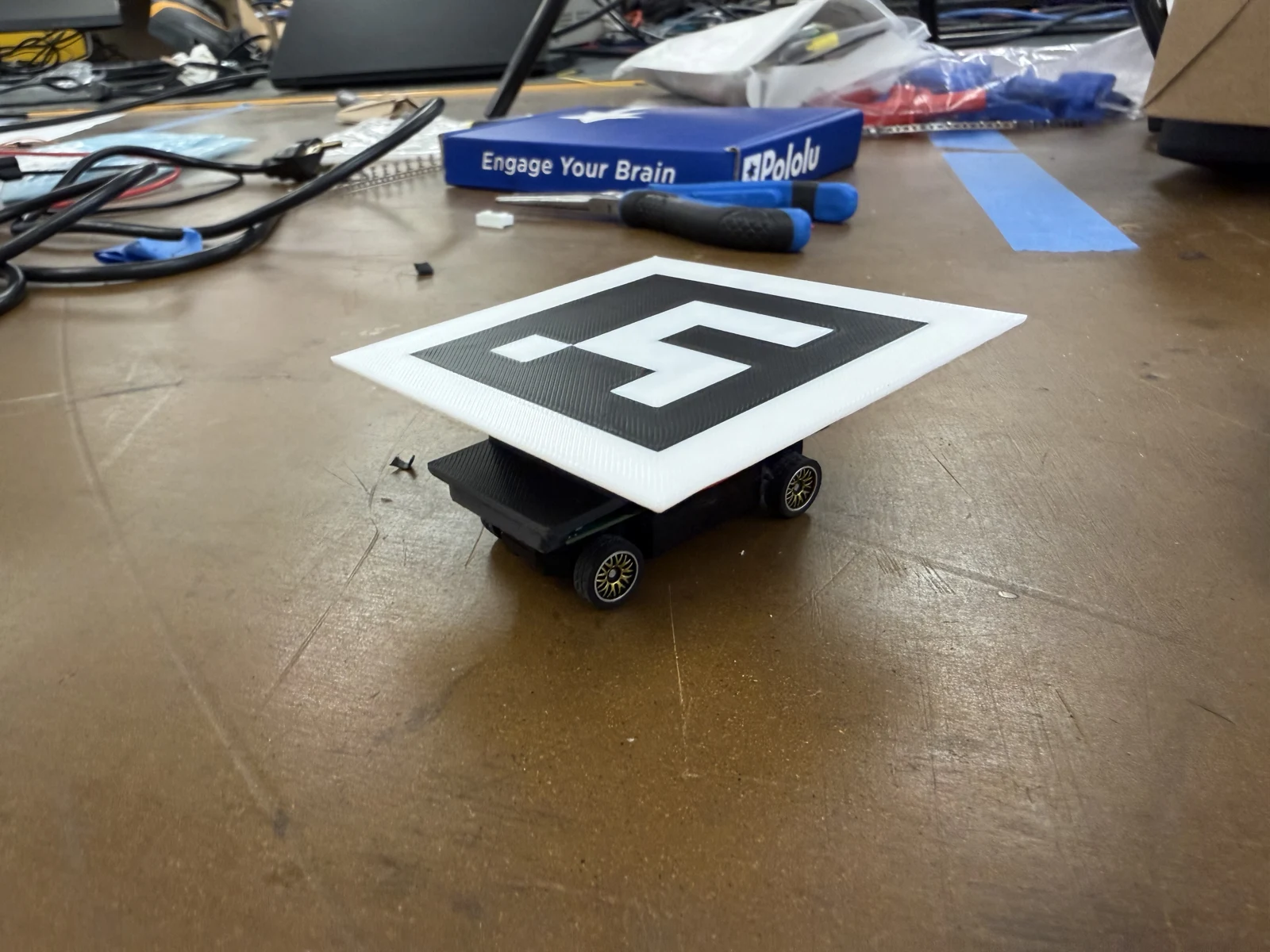
Full-size autonomous-driving experiments are expensive and difficult to repeat. Our capstone goal was to create an accessible system for training multiple driving agents in real life. A 2.5 × 2.5 m modular track gives us a controlled place to explore the gap between simulated and physical driving.
 Full size
 Full size
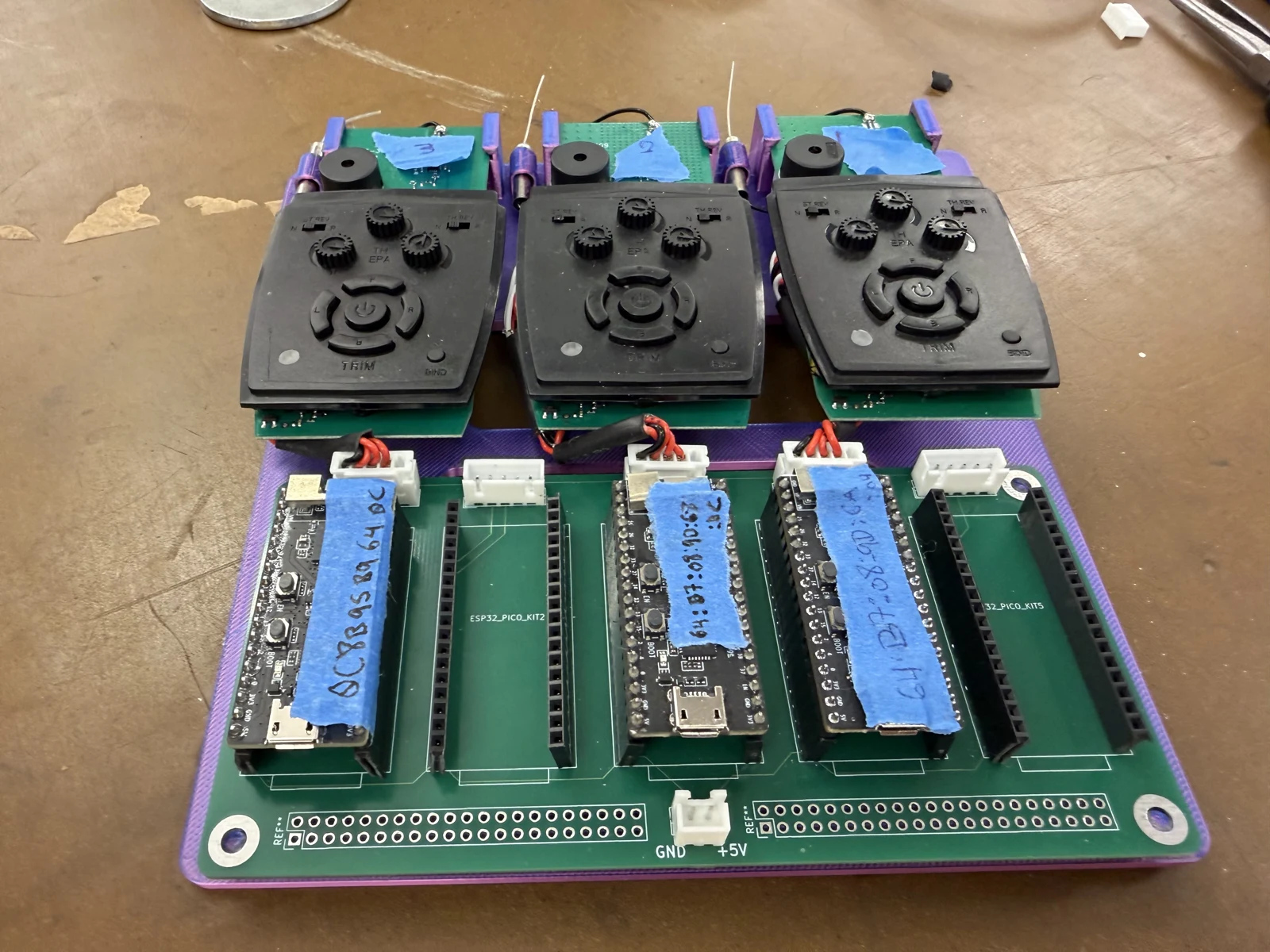
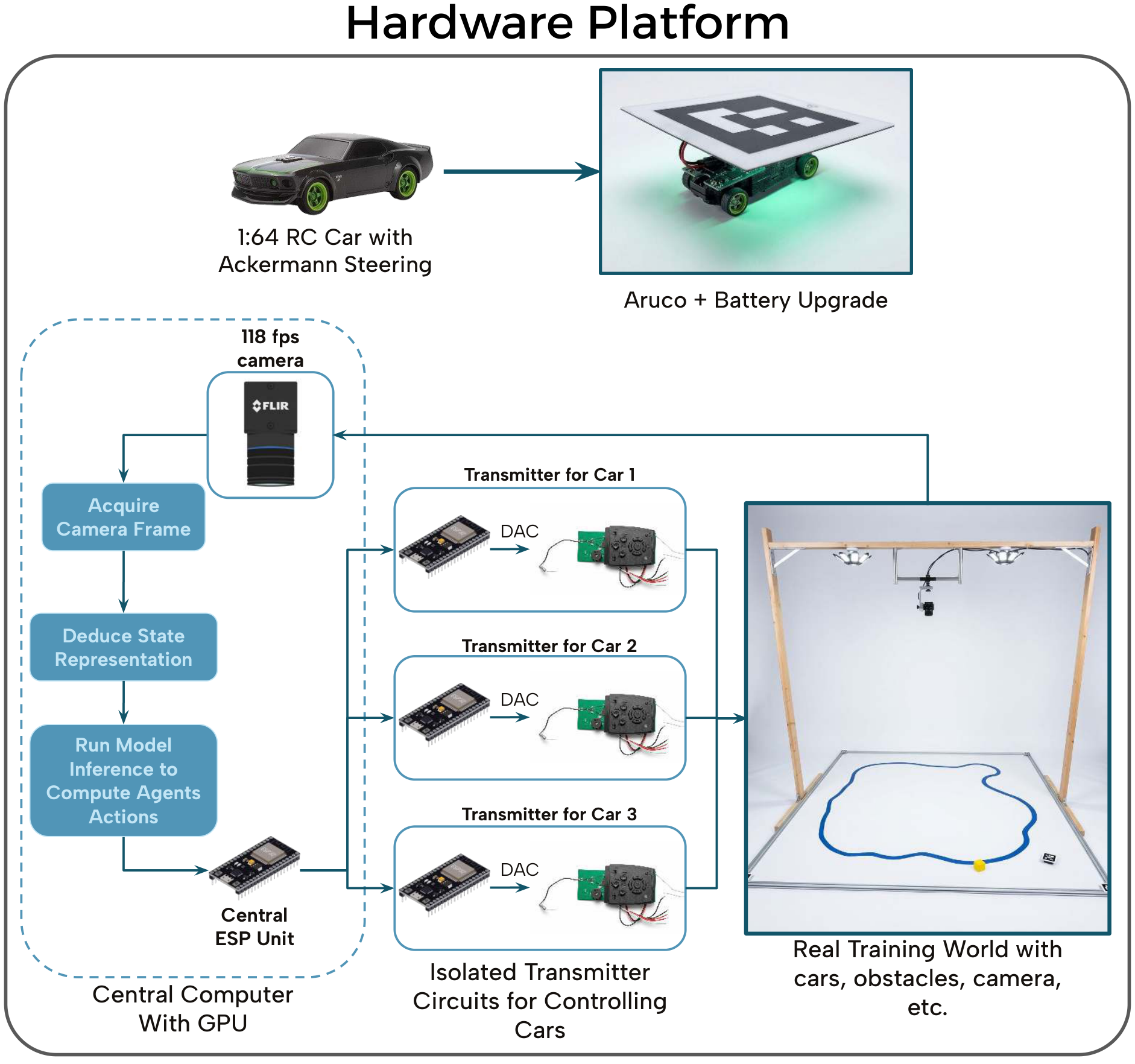
An overhead FLIR camera localizes the vehicles. The central computer computes observations and runs policy inference, then sends car-ID-prefixed commands over USB serial to a master ESP32. ESP-NOW routes each command to the corresponding receiver; DAC outputs drive the modified RC transmitter. Computation stays on the host computer.
 Full size
Computer vision · Coordinate transforms · Observation design
Make simulation and reality speak the same language
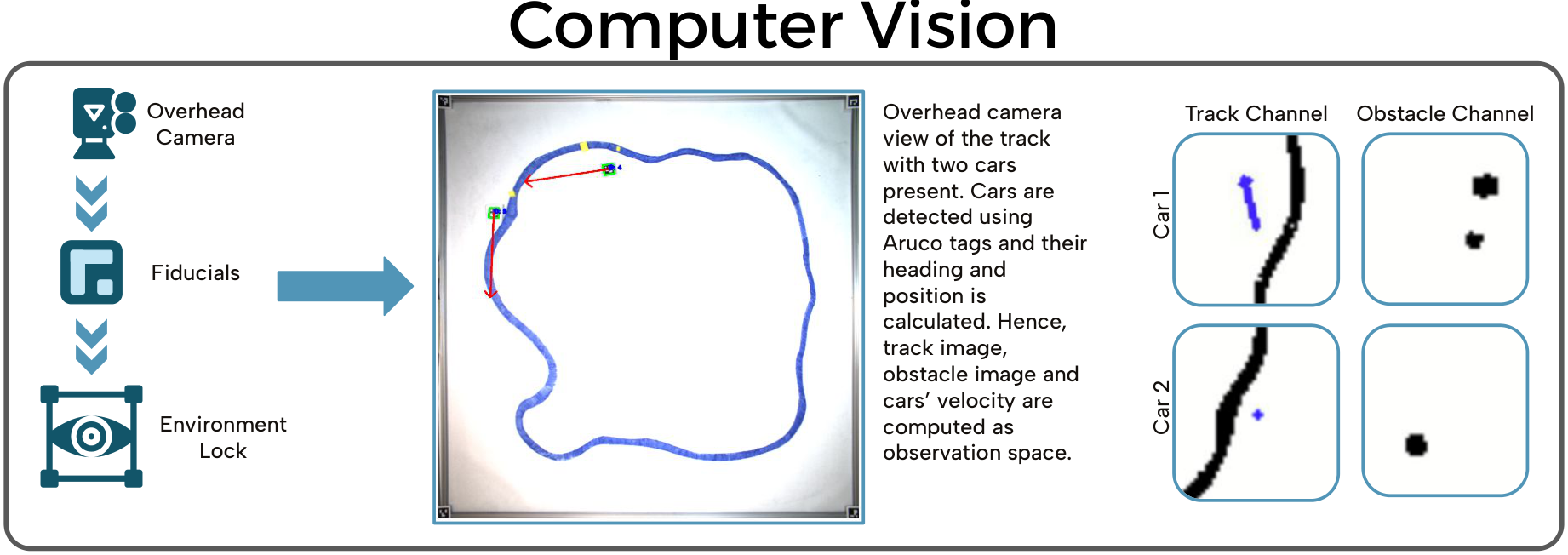
The policy does not need the entire camera image. ArUco markers provide vehicle position and heading; HSV segmentation separates the track and obstacles. The pipeline crops and rotates these maps around each car so that observations are expressed in the agent’s own frame.
 Full size
A binary track crop gives the line-following policy its local visual context.
A normalized velocity vector supplies motion information alongside the image.
A second binary image encodes obstacles and, for multi-agent tasks, nearby cars.
Matching crop scale, orientation, normalization, and action conventions across both environments makes the learned policy reusable. In the multi-agent simulation, stacked frames also give the policy temporal information about other cars’ motion.
CNN feature extraction · Actor–critic learning · PPO
From a track image to steering and throttle
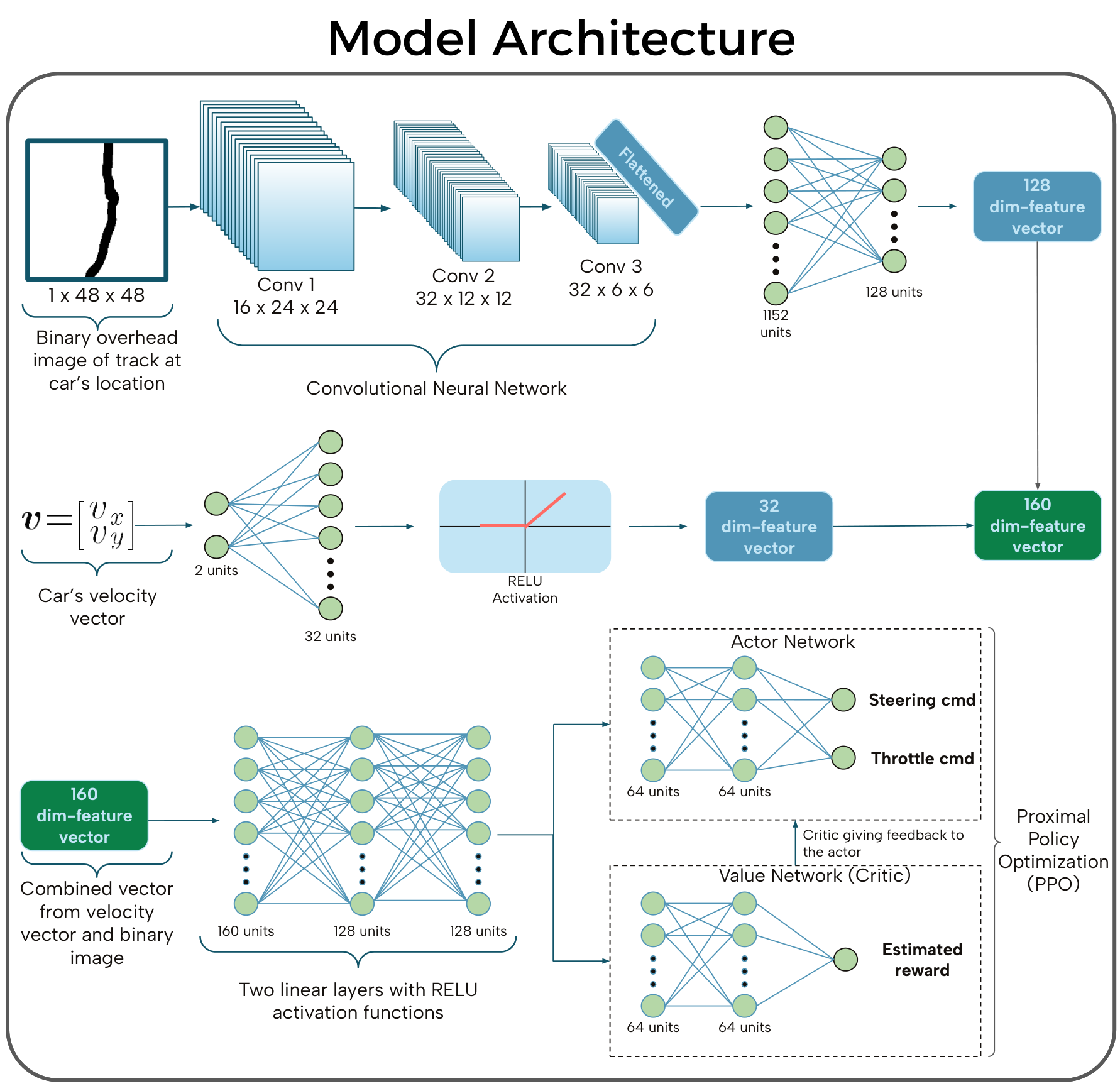
We trained policies with Proximal Policy Optimization (PPO) using Stable Baselines3. The line-following model combines a convolutional image encoder with a velocity encoder, then uses an actor–critic architecture to learn continuous driving actions.
 Full size
| Stage | Representation | Purpose |
|---|---|---|
| Visual encoder | 1 × 48 × 48 → 16 × 24 × 24 → 32 × 12 × 12 → 32 × 6 × 6 | Extract local track geometry through three convolutional layers. |
| Feature fusion | 1,152 flattened values → 128 image features; 2 velocity inputs → 32 features | Concatenate vision and motion into a 160-dimensional representation. |
| Shared layers | 160 → 128 → 128, with ReLU | Combine spatial context and vehicle motion. |
| Actor and critic | Separate branches, each with two 64-unit hidden layers | The actor produces steering and throttle; the critic estimates expected discounted return. |
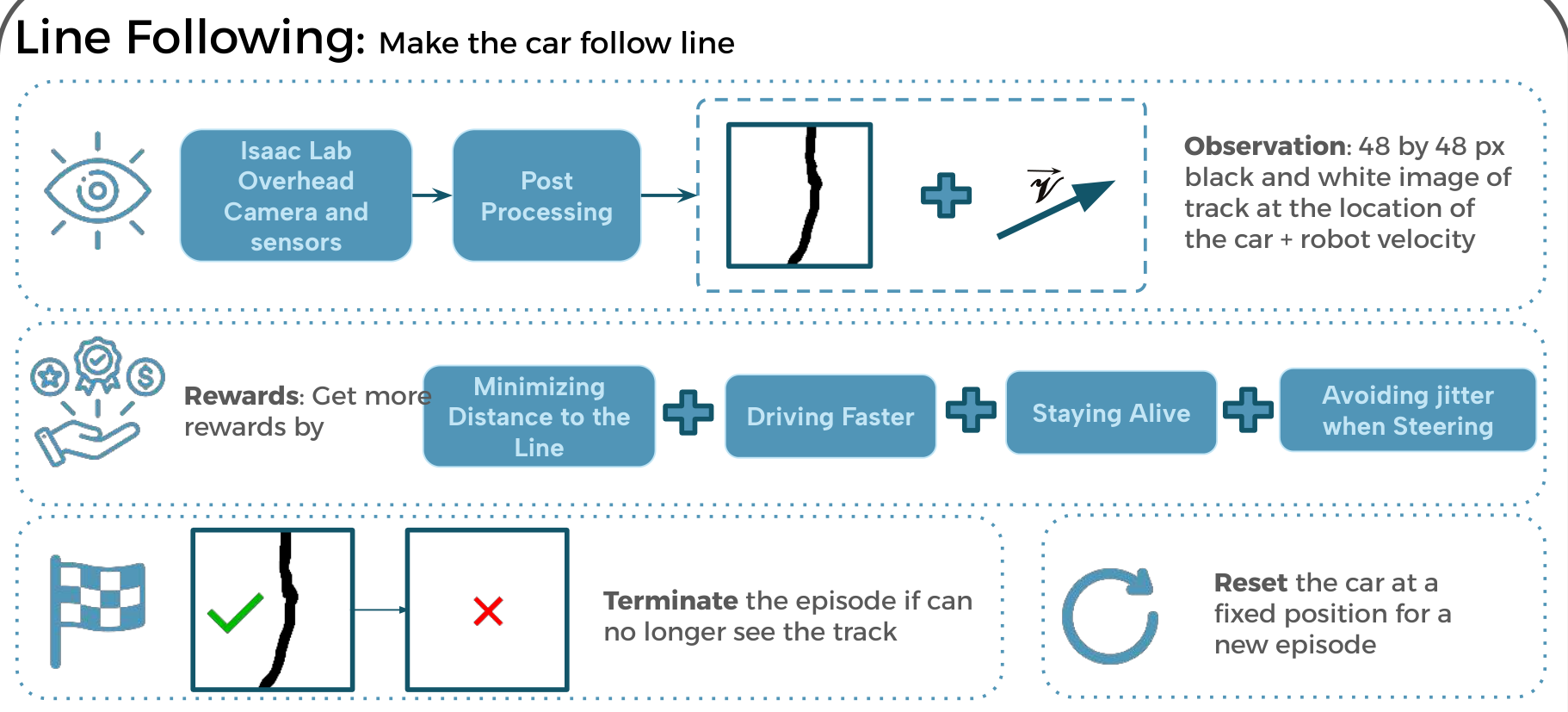
PPO alternates between collecting rollouts and updating the policy with a clipped objective. Reward design connects that optimization to useful driving: stay close to the line, move forward, remain on track, and discourage erratic steering. The critic supports training; the actor selects the driving action.
Isaac Lab · Vectorized environments · Reward design
Build driving skills in simulation first
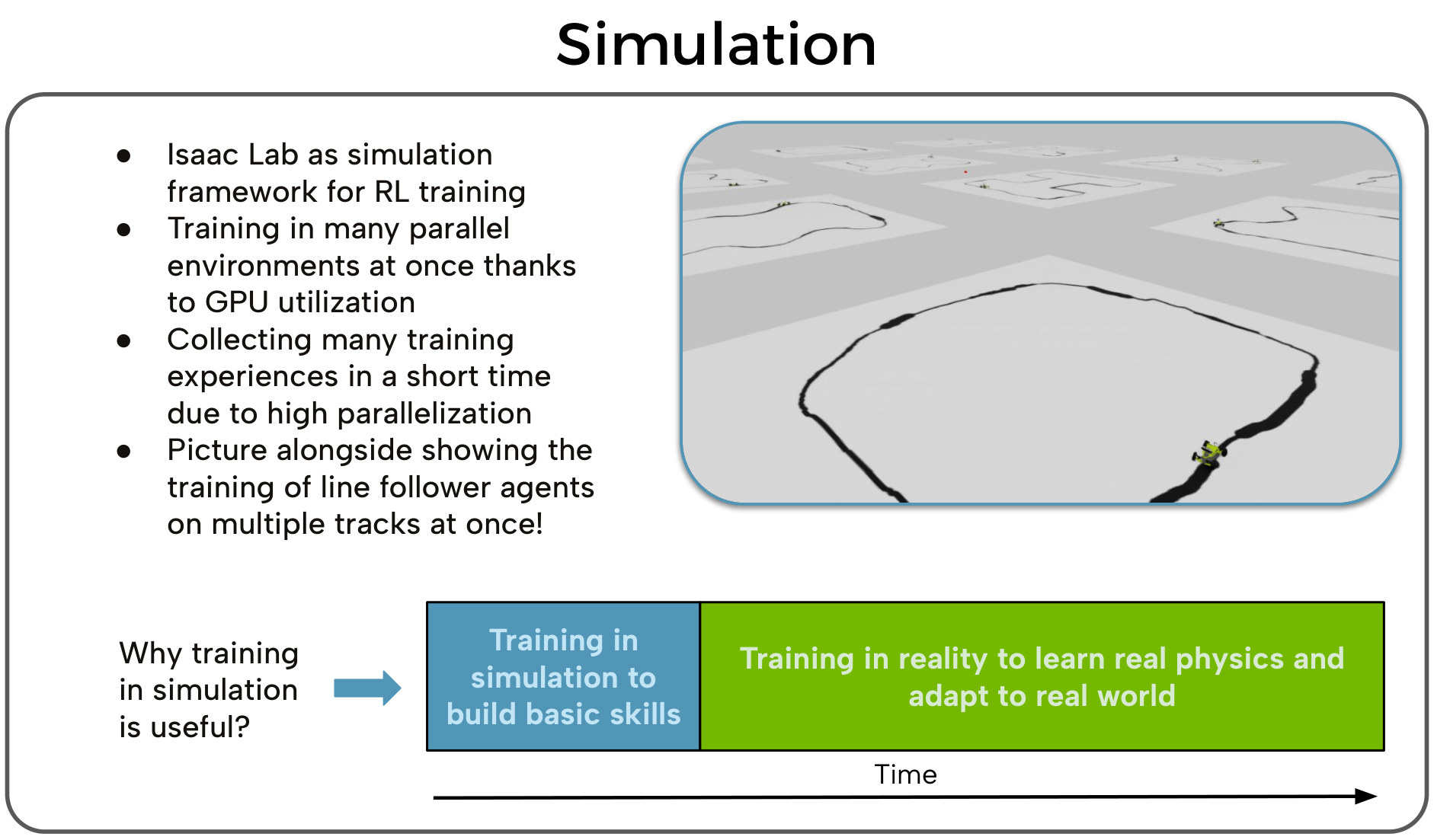
Our Isaac Lab environment models an Ackermann vehicle, track geometry, and overhead observations. Parallel environments make it practical to test rewards and observations quickly. The report describes 12 track variants for line following, with static track images cached as tensors to avoid repeated rendering. Observations, rewards, actions, and terminations are vectorized for GPU execution.
 Full size
Line following
The foundation: learn to follow the visible path using the local track image and velocity. An episode ends when the track leaves the observation, and the simulated car resets for another attempt.
 Full size
Obstacle avoidance
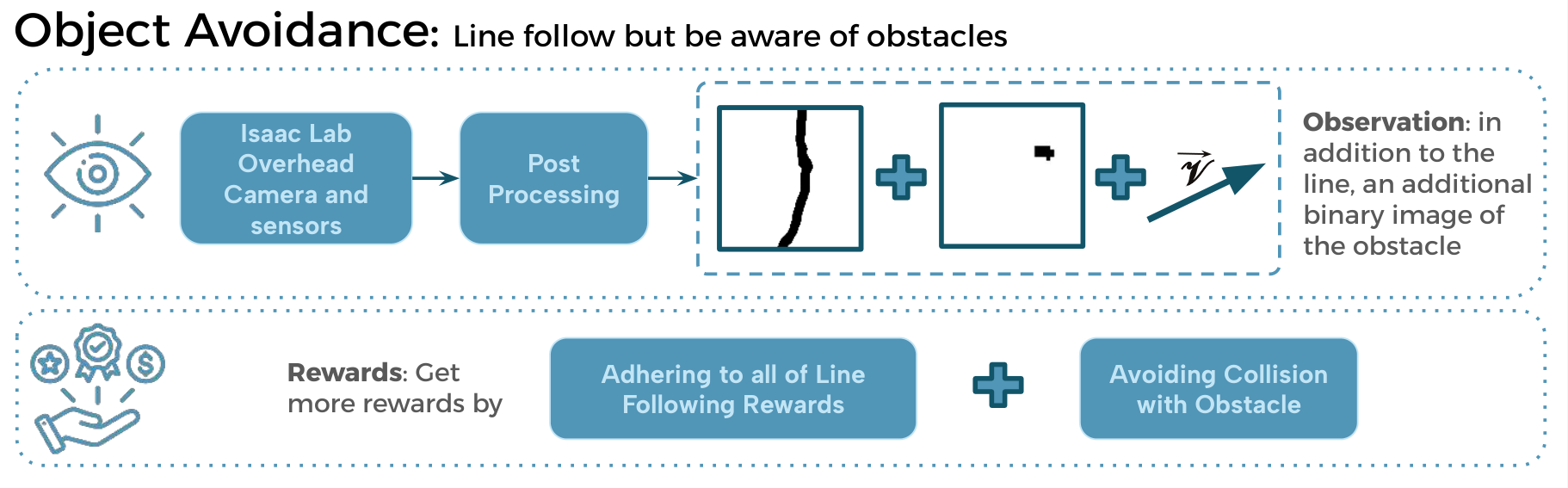
Add a second image channel for obstacle locations. The policy must leave the line when needed and rejoin it afterward, with collision handling added to the task.
 Full size
Multi-agent driving
Other cars appear in each agent’s obstacle channel. Experiences from multiple simulated agents train a shared policy, with frame stacking to represent motion. This creates interactions such as following another vehicle or meeting an oncoming car.
Sim-to-real transfer · Real-world rollouts · Automatic recovery
Deploy the policy. Then let the real world teach it.
Zero-shot transfer means deploying the simulation-trained policy without further learning. It worked well for basic driving on our physical track. But successful transfer does not eliminate the reality gap: motor response, tire slip, battery state, sensing noise, and control delays can still affect speed and smoothness.
The action interface stays consistent: normalized steering and throttle commands are mapped to simulated joint controls or to the physical controller’s 8-bit command range. Rather than trying to model every physical effect perfectly, we used the pretrained policy as the starting point for real-world PPO fine-tuning.
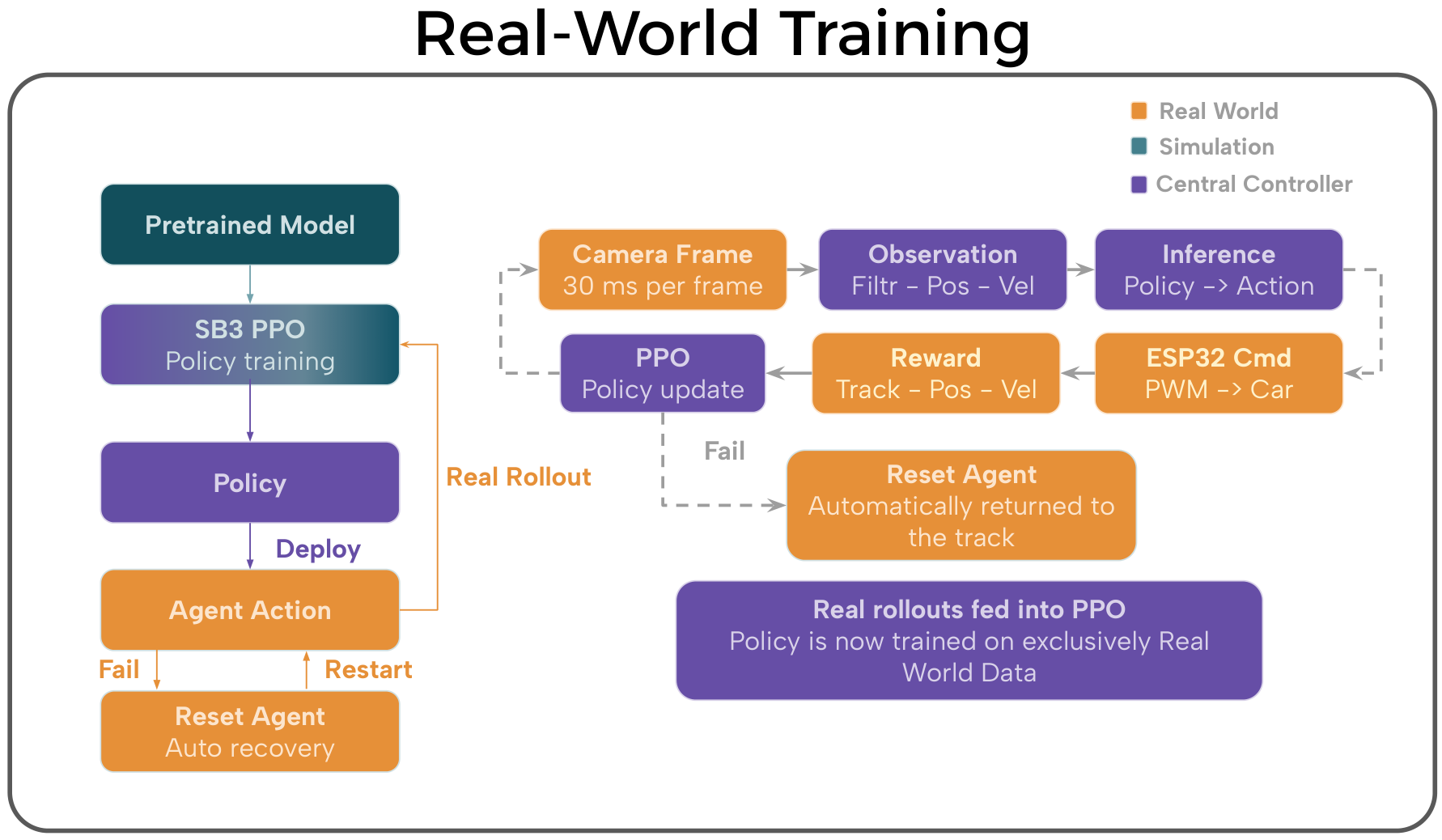 Full size
The crucial difference: a real car cannot teleport
Resetting in simulation takes one command. Resetting in reality requires driving the car back. We trained a separate goal-reaching policy from a vector observation: displacement to the goal, nearest boundary, heading error, and speed. It learns to approach the target, align, and stop, allowing driving episodes to restart automatically.
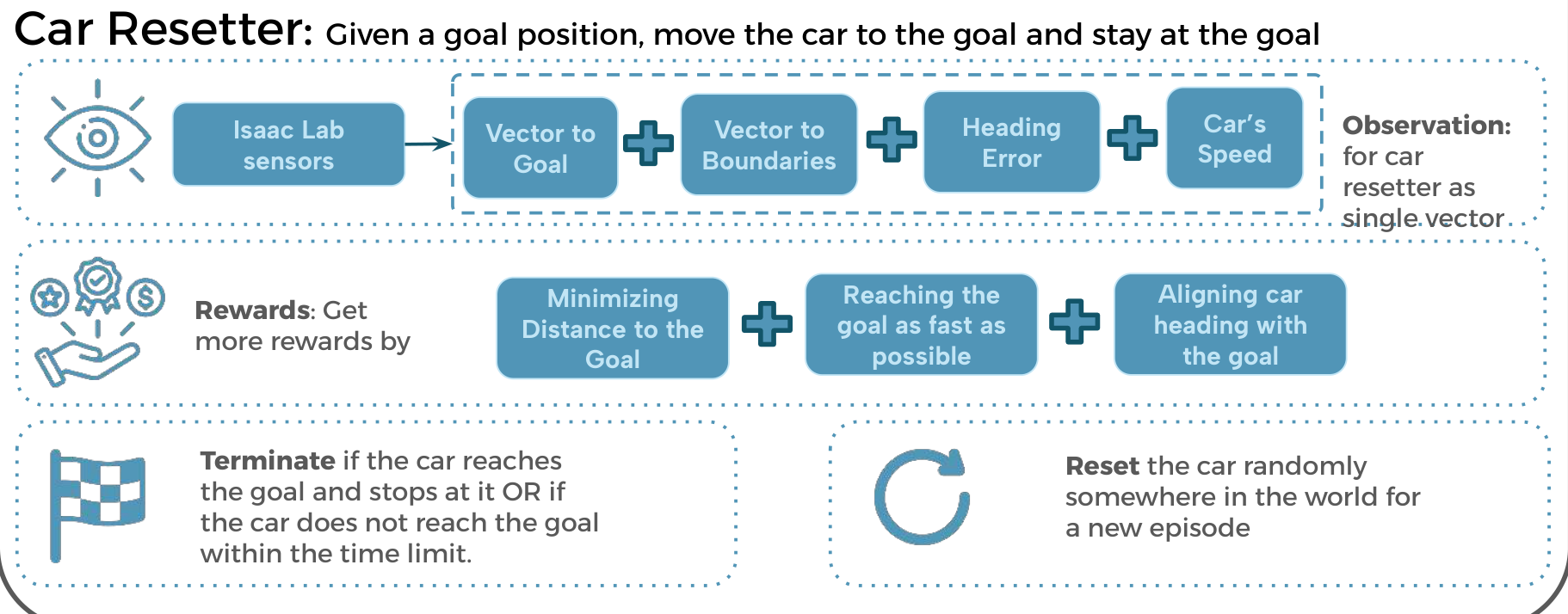 Full size
Evaluation · Experiment design · Engineering tradeoffs
What the platform demonstrated
| Capability | Demonstrated outcome |
|---|---|
| Zero-shot transfer | Simulation-trained policies drove on the physical platform. Basic line following transferred successfully, while oscillations and higher-speed tracking remained motivations for adaptation. |
| Single-agent fine-tuning | The final report records approximately 170,000 real-world steps over 3–4 hours, with learning rate reduced from 3 × 10⁻⁴ to 1 × 10⁻⁴. It reports improved line-following performance after fine-tuning. |
| Physical multi-agent driving | Multiple cars drove in the real environment, as shown in the supplied demonstration. This is distinct from jointly fine-tuning multiple agents in reality. |
| Scalable control | The report documents three simultaneous vehicles commanded at 60 Hz. Camera frame rate, command rate, and end-to-end policy timing measure different parts of the system. |
The April 2026 report describes an earlier project snapshot. The physical multi-agent result above incorporates the subsequent demonstration supplied for this case study. The recordings show behavior; they are not a controlled before-and-after benchmark.
Skills I developed through this capstone
This five-person project connected reinforcement learning to a working physical system. The technical work strengthened my experience with Isaac Lab, PPO and actor–critic models, CNN observations, reward and termination design, simulation-to-real interfaces, and evaluating policies through real-world experiments.
It also developed my systems-integration experience: understanding how visual tracking, coordinate frames, communication, vehicle dynamics, and automatic recovery affect the learning loop as a whole.
Further research
From a working platform to richer interactions
The next extension is more complex paths, denser obstacles, and more physical agents trained and fine-tuned together. The infrastructure now supports asking harder questions about shared policies, interaction, recovery, and adaptation.
- Introduce intersections and more challenging path geometry.
- Increase obstacle density and evaluate robustness across layouts.
- Scale real-world training and fine-tuning to multiple agents.
- Measure collisions, completion rate, tracking error, and recovery time across controlled experiments.
People behind the platform
A team-built research testbed
Developed by Sasan Ghasaei, Felipe Garavelli, William Gibbs, Itai Boss, and Mahdi Shakouri Ganjavi for UBC Engineering Physics, sponsored by Dr. Matt Brown and Dr. Daniele Reda at Wayve Technologies Ltd.
The architecture and results presented here reflect the team’s capstone work.
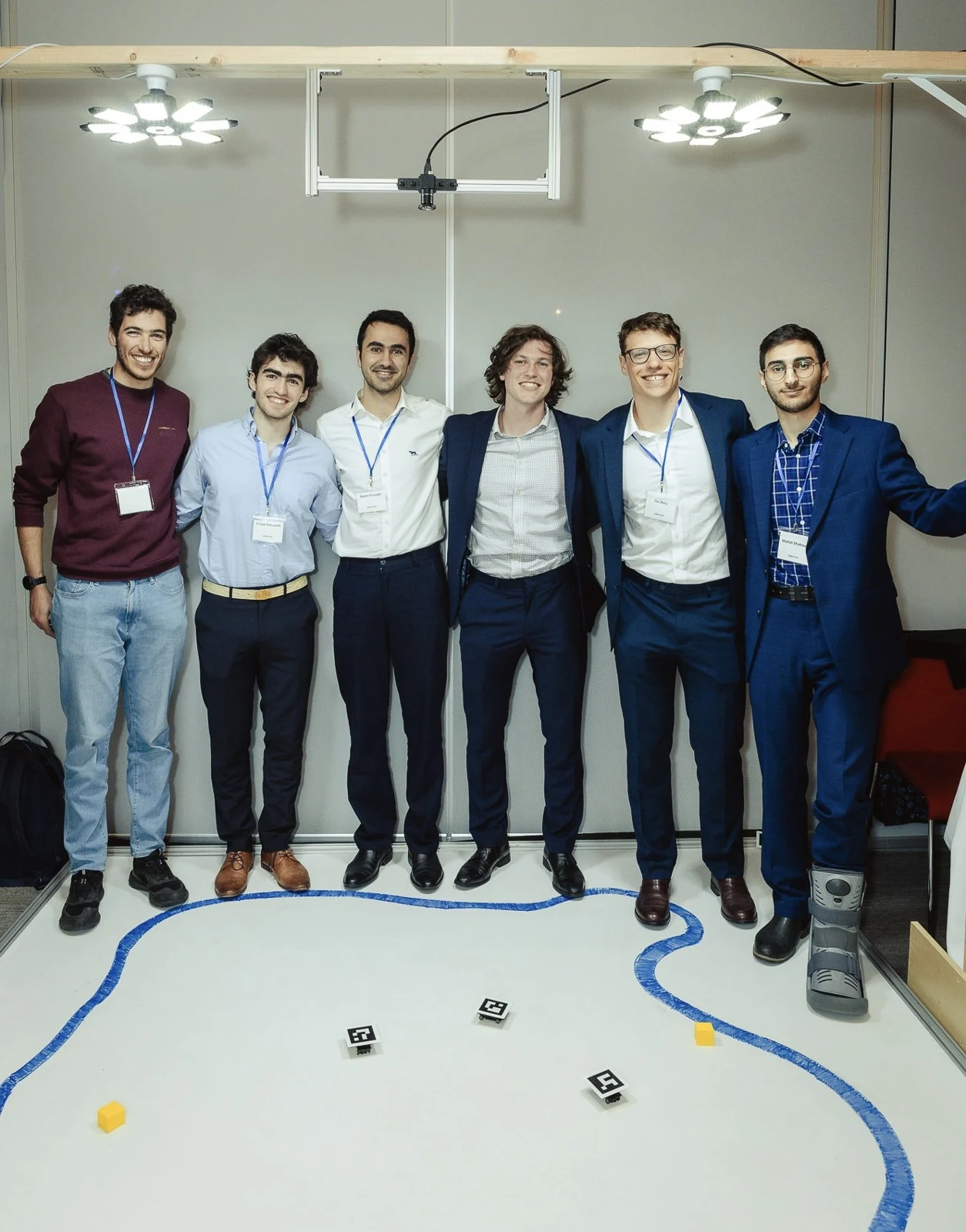 Full size
Project recognition
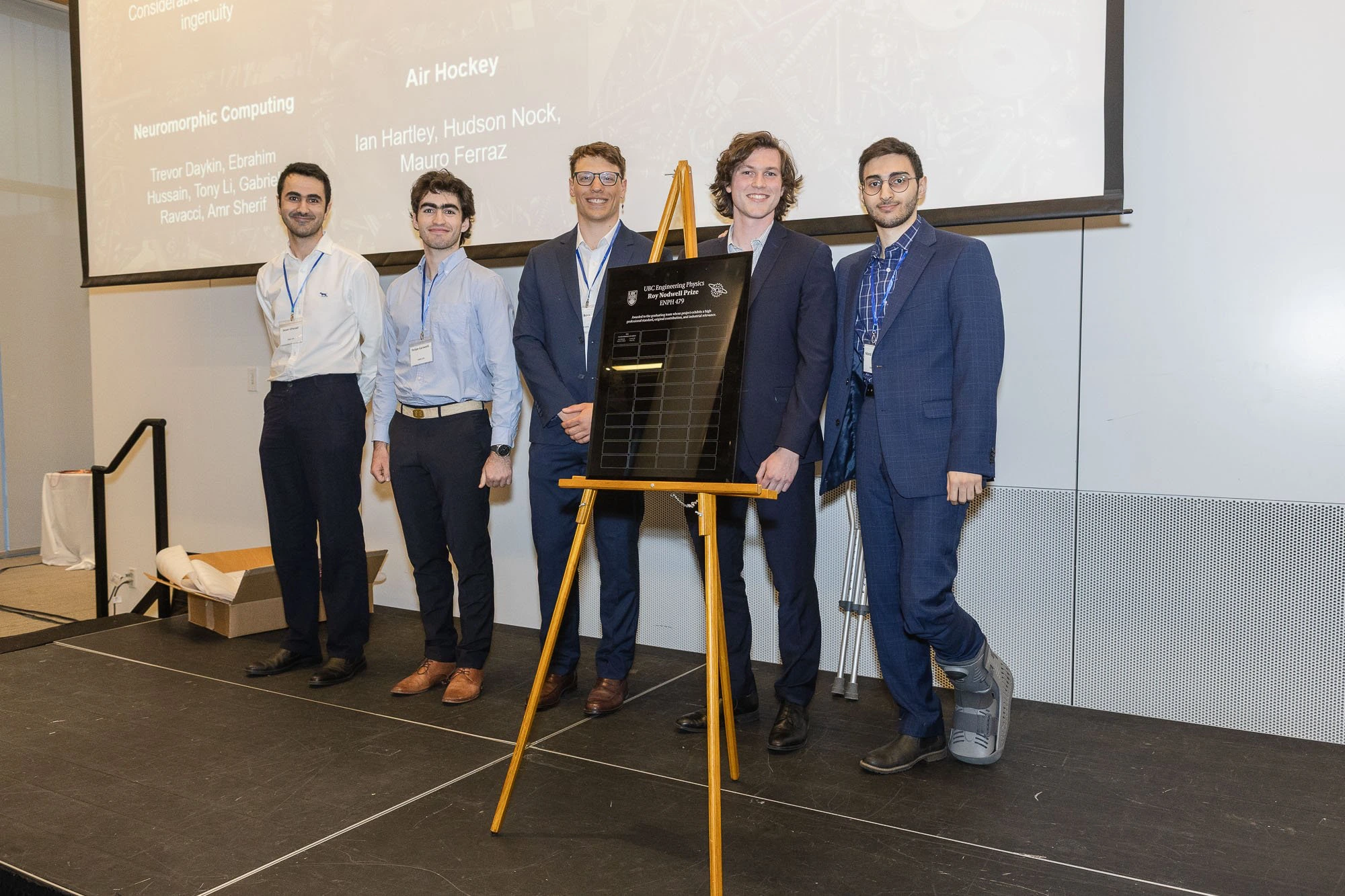
Roy Nodwell Prize
Our capstone team received the Roy Nodwell Prize, recognizing a project of the highest standard for its originality and industrial relevance.
The prize commemorates Roy Nodwell’s retirement in 1983 as head of UBC’s Department of Physics and Astronomy.
 Full size